Property Line Guide
Property Line Guide: Start Here Before You Map Any Boundary

Good property line work balances fast map orientation with disciplined fact gathering before commitments are made. With Find Property Lines, Land Buyers and Land Curious can move from rough boundary questions to a documented process that supports better decisions.
This article is about property line mapping for homeowners and land buyers. You will see how to review parcel context, test assumptions in the field, and prepare survey-ready notes before any legal or contractual decision.
Start on the desk, not in the field. Review parcel geometry first, then trace likely line turns with clear notes about confidence. This creates a clear first-pass map interpretation you can test instead of defend.
Then move to practical validation. Use landmarks and visible improvements to test your map interpretation before making commitments. The objective is clarity, not certainty claims.
Why This Matters
Boundary mistakes usually start when someone treats one map view as final truth. For Land Buyers and Land Curious, this matters because you can screen opportunities earlier and avoid driving to parcels that fail basic boundary checks.
A repeatable workflow improves communication across brokers, neighbors, engineers, title teams, contractors, and survey professionals who all need the same factual baseline.
Use Case
Land Buyers and Land Curious
Early parcel discovery before site visits, offers, and due-diligence deadlines.
- Screen parcel boundary context before driving long distances for a visit.
- Compare map geometry with listing claims and visible land features.
- Prepare structured questions for brokers, title teams, and surveyors.
How This Works in the Field
A buyer reviews an out-of-county parcel, notices a boundary question near road access, and resolves it before scheduling inspections.
Package your notes so every open question is clear before paid professional work starts. This keeps broker, title, and survey conversations focused on specific segments instead of generic concerns.
Before acting, build one evidence packet that combines map screenshots, dated notes, and unresolved questions. A single packet prevents rework and keeps everyone aligned on what is known versus what still needs confirmation.
When This Property Line Workflow Is Useful
- Screen parcel boundary context before driving long distances for a visit.
- Compare map geometry with listing claims and visible land features.
- Prepare structured questions for brokers, title teams, and surveyors.
- Initial property line orientation before site visits or calls with professionals.
- Quick comparison of parcel geometry and on-map line candidates.
Step-by-Step Property Line Process in Find Property Lines
- Open Find Property Lines, search the parcel, and capture a first-pass boundary orientation view.
- Start with parcel context, then trace a preliminary property line path corner by corner.
- Compare turns and distances against any available plat, deed notes, or county map references.
- Save screenshots and notes so your property line assumptions are transparent and auditable.
- Before any legal or contractual action, hand off the file to a licensed surveyor.
App Interface Preview
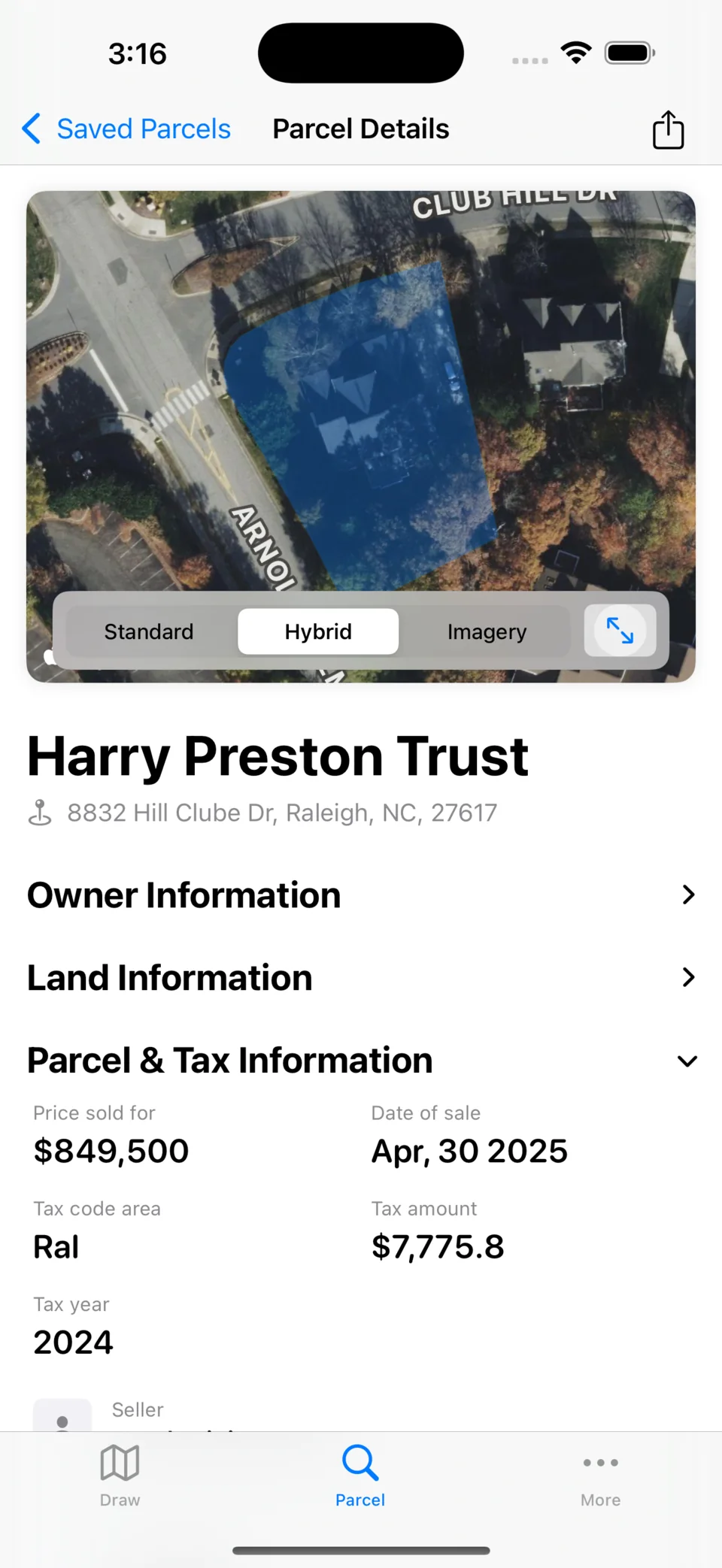
This is a real screen from Find Property Lines used in property line workflows for Land Buyers and Land Curious.
What to Collect Before You Decide
- Parcel overview image showing the full boundary context.
- Segment-level screenshots for corners and direction changes.
- Field note log with dates, observations, and confidence flags.
- List of unanswered questions for title, survey, or local professionals.
- Decision-impact summary describing what can proceed now and what must wait.
Property Line Verification Checklist
- State the decision tied to each note (offer, layout, fence, permit, valuation, routing, or stewardship action).
- Capture at least one full-parcel screenshot and one close-up screenshot for every uncertain segment.
- Cross-check line turns against parcel context, imagery, and available deed/plat references.
- Record corner observations with time, position context, and confidence level.
- Flag every unresolved segment before permits, contracts, fencing, construction, or closing.
Decision Moments That Need Extra Verification
- You are about to sign, fence, build, permit, or close based on boundary assumptions.
- Neighbors, buyers, or contractors are interpreting the same edge differently.
- A corner location is uncertain after desk and field checks.
Common Mistakes to Avoid
- Treating one map trace as final instead of documenting confidence and uncertainty.
- Skipping cross-checks between parcel layers, imagery, and field observations.
- Making improvement, pricing, or contract decisions before resolving high-risk segments.
- Collecting screenshots without linking each one to a specific decision question.
- Escalating too late, after timelines and budgets are already committed.
Where Professional Survey Confirmation Is Required
- Find Property Lines is designed to speed up planning, measurement, and documentation workflows.
- Parcel layers, imagery timing, and GPS behavior can introduce offsets in some locations.
- Final legal boundary determinations and formal dispute outcomes require licensed professionals.
For legal boundary determinations, disputes, permits, and title-sensitive decisions, consult a licensed land surveyor and local professionals.
FAQ
How does Find Property Lines help with property line work?
Find Property Lines helps you search parcels, measure and compare candidate boundaries, and organize notes/screenshots so every boundary question is explicit before you spend on field work.
Why can a property line map differ from what I see on the ground?
Map imagery dates, parcel data quality, and GPS variability can create visible differences. Treat mismatches as verification signals, not final conclusions.
When should I bring in a licensed surveyor?
Bring in a surveyor when decisions affect contracts, permits, setbacks, legal disputes, or final boundary placement. Your app notes make that handoff faster and clearer.
How detailed should my notes be before I ask for professional help?
Detailed enough that a surveyor can see exactly which segments, corners, and assumptions need confirmation.
Continue Reading
Property Line Guide: Start Here Before You Map Any Boundary
Core property line workflow from first map check to professional escalation.
- Property Line Finder: Step-by-Step Property Line Workflow on iPhone
- I have a property line dispute with my neighbor. Can your service help me?
- My property has never been surveyed. Can I use the coordinates you provide to mark my property corners on the ground?
- Can I use your coordinates to determine if my neighbor's building or my neighbor's road is on my land?
- Do the approximate corner coordinates your service produces establish the corners for a piece of property that has not been surveyed?
- What do land surveyors think about your business?
Try Find Property Lines on iPhone
Use the app to screen boundaries fast, then validate with title and licensed survey professionals.
Disclaimer
This content is for general educational and planning purposes only.
Find Property Lines does not provide legal advice, cadastral determinations, title opinions, engineering certifications, or licensed land-survey services.
Map overlays, parcel layers, imagery, and GPS-based measurements can contain errors, offsets, stale data, or omissions and must never be treated as legal boundary proof.
You are solely responsible for verifying all boundary, ownership, permitting, tax, zoning, and contractual decisions with licensed professionals before relying on any output.
To the maximum extent allowed by law, we disclaim warranties and liability for direct, indirect, incidental, consequential, special, or punitive damages arising from use of this content or app output.